 tom bh
Religious Studies On Software Engineering
15 September 2026I graduated from Lampeter University, Wales in 2006, with a 2:1 in Religious Studies. Whilst I’ve earnt all my money since then from the seemingly unrelated world of software, my degree has been invaluable. One of the many academic definitions for religion is, “the state of being ultimately concerned”1. Ultimate concern can be seen in those great questions of life; what is existence, what is our purpose, what does it mean to be good, why do we suffer? Although Religious Studies explicitly doesn’t offer any answers to these questions, it is a discipline that is ultimately concerned with taking those that ask these questions seriously.
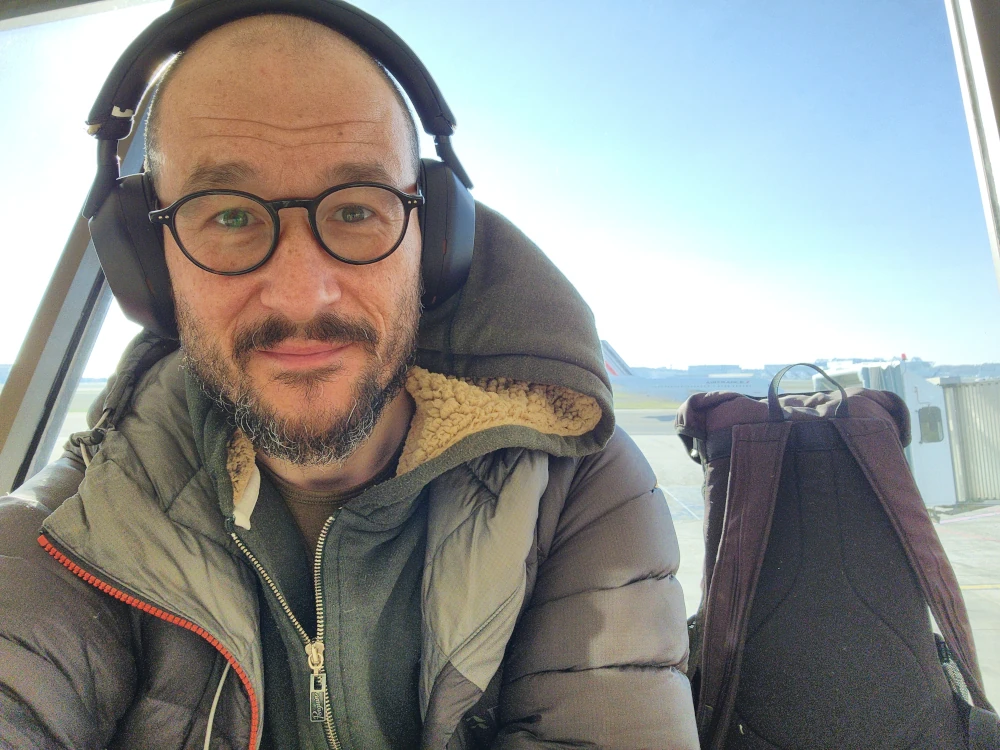
Since 2015 I’ve been continuously travelling the world. Not having a fixed home has meant that I’ve slowly but surely reduced my possessions to a bare minimum. My entire worldly belongings fit in this 30 litre daypack:
Despite its small size, I still carry some items of sentimental value. One of which is this handout from our Buddhism module:
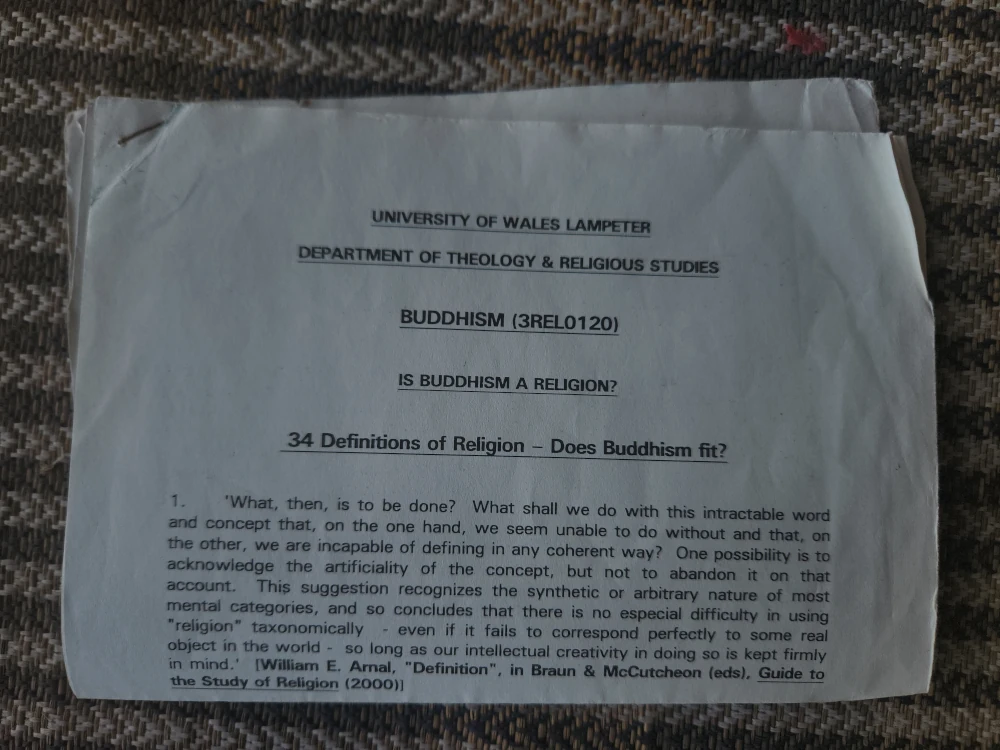
It contains a very much non-exhaustive selection of some 34 definitions of religion. Buddhism is an Eastern tradition and so has had a unique effect on the Western tradition of Religious Studies. Whilst Buddhism is clearly a fully-fledged religion, it is, in stark contrast to mainstream Western religions, godless. So however we define religion, it needs to take this and indeed many other diverse human beliefs and practices from around the world into account. This makes agreeing on one true definition hard if not impossible.
I think we can rightly be suspicious of a field that doesn’t precisely know what it’s actually studying. But for me this has always been one of the most interesting and useful aspects of my training. How do you sincerely and rigorously take something seriously without knowing what it is?
The Insider/Outsider Problem
One framing we were taught to approach this with was the Insider/Outsider problem. Those best suited to knowing what a given religion is, are those that practice it, namely insiders. But because of their commitment and investment they are also those most likely to be biased. Whilst outsiders on the other hand can be more objective, they’re also problematic as they’re not directly exposed to the subject of study. Therefore we should strive to consider both perspectives in order to arrive somewhere in the middle. We can do this both academically and personally.
Academically, we can consider both the outsider studies of say, anthropologists and the insider accounts of believers. Personally, as outsiders, we can be curious and think critically, but we can also, more interestingly, allow ourselves to be genuinely moved as sincere visiting insiders to specific responses to questions of ultimate concern. But given religion’s track record over the millennia, this seems dangerous. Why dignify some of the most damaging ideas in human history by letting them into our personal lives? For me this gets to the heart of what Religious Studies is and what I’ve found most valuable about it in my life and career over the last two decades.
Given the fact that religion is not easily defined, we must be prepared to entertain the fact that, whatever the dimensions of religions are, some of those dimensions may be present in worldviews that don’t immediately appear religious. Think of how capitalism puts money above all else to the detriment of social and ecological welfare. Profit may not be a god in the traditional sense, but the way in which it so fundamentally permeates modernity notably echoes the great world religions like Buddhism and Christianity. Whilst it is perfectly possible for somebody to not profess any ism of any kind, I think Religious Studies shows us that we’re all, to some extent, inevitably inside one ism or another. That’s not to suggest that anybody can speak as if inside any other religion or ism. But rather that Religious Studies, in its sincere and holistic approach, neither demotes religiousness to a mere object of scientific dissection, nor promotes it to a source of unverifiable truth. I always have been and still am, deeply sceptical of religion. But I don’t get to smugly point at it from my high horse thinking I’m a “clean” outsider untainted by insider-ism.
One of the fathers of Religious Studies, Ninian Smart, had this to say about the Philosophy Of Religion, an adjacent discipline focussed on religious truth claims2:
The fabled Martian arriving on the planet and inspecting among other things our intellectual resources might also be struck by a strange thing. Journals he would note, devoted to the philosophy of religion. The more advanced essays therein might discuss the question of truth as between religions. But over Cambodia he would not look down to perceive Christians struggling spiritually with Buddhists: he would find Marxist rural anarchosyndicalism destroying temples and monks. In Tibet he would see the clash of ancient religion and Maoism. In Romania he would note subversive Baptists. In Sweden he would see Christianity softly overwhelmed by social democracy. In brief, he would think that as far as rivalry goes […] religions and ideologies were tugging against each other, and that really from a practical point of view it was odd that such a struggle was rarely depicted in the journals of the philosophers of religion. […]
He might be further puzzled at how blithely men could come to put religion in a sort of ghetto, considering so many professed not to be able clearly to define it.
To a Martian the difference between religion and ideology is academic. What’s paramount and starkly obvious is that, whatever its name, it’s one of the defining aspects of earthly life.
Earthly Life
My father died from alcoholism during my final year at university. I am forever grateful for how immensely supportive my tutors were during that time. Just a few weeks after his death our final exams started. For my Buddhism exam I chose to answer the question, “Why Do Buddhists Meditate?”. It was a topic close to my heart as I had myself been meditating daily for 5 years at that point. As I entered the exam hall I unexpectedly saw my ex-girlfriend. I kept my composure, but when I came to write the words, “…as opposed to a belief, meditation as a practice exists beyond statements on the true nature of things…”, I broke down in tears. I was overwhelmed by the convergence of so many things; academic achievement, personal fulfillment, loss and love. My tears softened the paper upon which I was writing such that any ink would run. I started writing again further down, leaving what must have appeared to be a curious empty paragraph.
I wasn’t just an outsider to my degree. It fundamentally shaped who I am. I literally, as in literally literally, submitted tears to my formal academic record.
In that same Buddhism module for which I still carry a handout, we also learnt that before the arrival of Alexander The Great in India during the 4th century BCE, the Buddha wasn’t represented in human form. Rather he was depicted by absence, such as an empty chair or footprints.
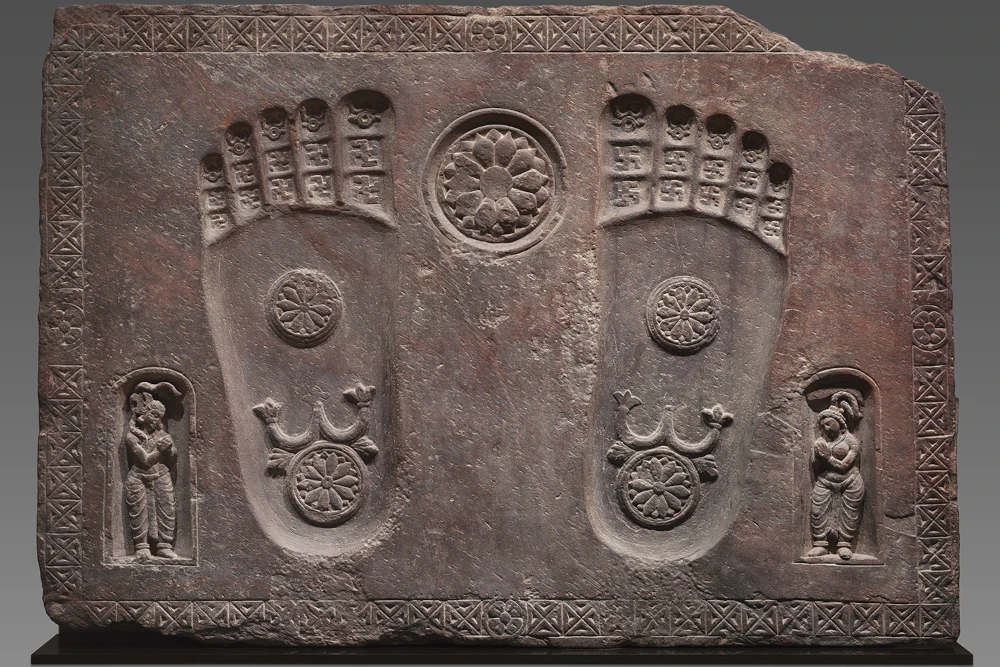 Buddhapada (Footprints of the Buddha). Gandhara, South Asia, 2nd century. Schist. Yale University Art Gallery.
There are various interpretations for why this was. My favourite is because it represented the central Buddhist concept of emptiness. Emptiness is often misunderstood as the idea that there exists some fundamentally empty dimension to existence. In fact, it’s just the observation that you can’t point to any one aspect of a thing in order to locate that thing. Typically this is applied to a person: whilst I am made up of my body, thoughts and feelings, I can’t point to any one cell, utterance or emotion and say that that is what I most fundamentally am. This can be applied to anything, even, as we have just seen, the definition of religion itself.
My empty paragraph, like the Buddha’s footprints, showed me that I was really there, that I didn’t just peer at my university experience from the outside. I saw, and still see, the temptation to blithely put religion in a sort of ghetto, to keep it at a safe distance, to believe that I am somehow above and beyond all that fantasy and violence. But questions of ultimate concern don’t leave me unscathed.
Once I’d graduated, I had to find a way to make a living. I’d learnt about software since before I could remember, from my father, the alcoholic. So whilst I already had some fluency in that world, it wasn’t immediately appealing. I wanted a roof over my head, but I wanted fulfillment too. How could the world of computers offer me the same warmth and stimulation as my degree? This is still a question I come back to time and time again, and even though the answers don’t always feel within reach, the tools and perspectives I was taught have time and time again guided me.
The Technologising of the Word
Another of my favourite course modules was Religion And Media. My first thought was that this was going to be about mass media, like how religion is represented on TV and the internet. But “media” here was more in the sense of the plural of “medium” of communication. We explored the effects that the four great paradigm shifts in media technology had on religion and culture; orality, literacy, print and digitisation.
It’s funny thinking of speaking as a technology. Did we invent it? It feels more like it was given to us by evolution. But there are nuances which are more concrete. In Walter Ong’s Orality and Literacy: The Technologizing of the Word he considers the power of narrative, rhyme and song. These are clearly our innovations, those ancient and perennially celebrated traditions of poetry and music for example. For millennia these media have been the dominant technologies recording and transmitting human knowledge across time and space. Carefully created stories, with engaging characters, stimulating adventures and performed with pleasing rhymes and melodies, are more easily remembered and more readily heard. Think of those poetic epics like The Odyssey or Ramayana.
Seen from the enormity of today’s digital revolution it’s hard to imagine how linguistic tools as seemingly trivial as song and story precipitated changes in the fundamental structure of human culture. But we can reasonably form an argument that this is where religion’s DNA emerges. Oral technology leads to codification. By preserving a particular representation of the world and events, it inevitably also favours particular views, opinions and indeed beliefs. We can even begin to imagine how it might contribute to social hierarchies: memorisation takes time, time that can’t be used for say manual labour. If the keepers of the stories become sources of truth then they are afforded certain powers over others. This is of course not an inevitably but it does sketch out the potential ramifications of what at first seem like inconsequential technologies.
It’s easier to see the relevance of writing on religion. Today we have what are considered to be 6 World Religions, religions that have spread across diverse geographies and cultures; Christianity, Islam, Judaism, Hinduism, Sikhism and Buddhism. These are all also religions for whom literature plays a central role. The written word is even more ossifying in its codifications and so even more pronounced in its effects on religion and culture.
Print continues the trajectory, but here it’s interesting to consider how media technology can also promote the opposite of codification, like secularisation for example. Clay Shirky argues that it was the printing press that led to the creation of the nation-state in Europe during the 17th century3. Until then the ultimate power in European states lay with the church. A large part of that power was mediated via Latin-speaking priests who were the single source of truth for interpreting labouriously hand-written and thus conveniently rare Latin bibles. The printing press made it economically viable to give ordinary people access to canonical Christian texts in the local vernacular languages. This undermined the power of the church, allowing other forms of political organisation to flourish.
Although digitisation, or let’s just say the internet for convenience’s sake, has obviously had a massive impact on humanity, I’d like to temper its commonly perceived impact. I suspect most of us, and especially myself as a software engineer, are problematically inside the convulsions of this paradigm shift. It’s hard to have an outsider’s perspective. I am after all writing this on, and you are likely reading it from, a digital device. As Marshall McLuhan said, “The medium is the message”4,
This is merely to say that the personal and social consequences of any medium – that is, of any extension of ourselves – results from the new scale that is introduced into our affairs by each extension of ourselves, or by any new technology.
Many of the richest companies in the world are digital; Amazon, Google, Microsoft, Apple, etc. Whilst all the others are themselves fundamentally dependant on digital products and services. The amount of power underlying digital mediums of communication inevitably shapes the messages it carries.
https://en.wikipedia.org/wiki/TESCREAL
For me, the ultimate example of digital insiderism is belief in the technological singularity, as espoused by writers like Ray Kurzweil5. The idea goes that, if the rate of technological advancement is itself increasing, then it stands to mathematical reason that at some point in the near future the rate of change will tend to infinity. A concrete pathway for this could be imagined via self-improving AIs. If LLMs are increasingly capable of writing software, and indeed the very software that creates themselves, as long as they have the necessary computing power, then in theory their evolution should become exponential. Which leads to a super-intelligence beyond human comprehension.
I don’t think it takes a Religious Studies graduate to notice the religious themes here. The singularity rhymes with monotheism, the traditional staple of Abrahamic religions; Judaism, Christianity and Islam. The predictions of an imminent upheaval sound like prophecy, a useful tool of charismatic leaders to attract and maintain followers without having to actually provide concrete evidence. And of course super-intelligence is another way of talking about omniscience.
I of course don’t know what the future holds, but I am at least sceptical of this sort of religious rhetoric. I would instead like to offer another perspective that I came across during my studies: the idea that responses to the questions of ultimate concern are cyclical.
The Sect-Church-Sect Cycle Theory
The roots of Sect-Church-Sect Cycle Theory can be traced back to well known sociologist Max Weber’s ideas about Church-Sect Theory in the 1900s. But I will outline the theory as it was later developed by the American sociologists Stark and Bainbridge in the 1980s6. Broadly speaking, a sect is an offshoot of a larger organisation like an established church for example. Classic examples in Christianity would be; Mormons, Baptists, Quakers, etc. The cyclic version of the church-sect split argues that most religions are in fact continuously moving back and forth along a church-sect spectrum. So for example, in many ways it can be said that Christianity itself started out as a sect within Judaism. And now Christianity has many sects, which themselves have become churches in their own rights. Consider how Protestantism broke off from Catholicism in the 16th century, and Evangelical Christianity broke off from Protestantism in the 18th century, which now has literal megachurches!
The proposed mechanism powering this cycle is the tension between the established religion and the surrounding society. Let’s see how this plays out by returning to the era of the printing press in Europe. For centuries, Christianity, or more correctly, Catholicism, was an all-pervasive, monopolistic, institution inseparable from the very fabric of society. This is The Church, with a capital C, it essentially held ultimate power, even over kings. It was the largest European landowner and levied a 10% tax from all members of society under its jurisdiction. The way to salvation was to receive The Seven Sacraments (Baptism, Confession, Eucharist, etc) which conveniently could only be performed by ordained priests. If priests, or indeed any members of the clergy broke the law, they weren’t tried in common courts, but ecclesiastical courts. A striking example of The Church’s dominance occurred in 1077, when King Henry IV defied The Pope. He was promptly excommunicated and so lost power over what is now the lands of modern day Germany, Italy and France. To regain his power he was forced to walk the Humiliation of Canossa: a journey over The Alps, to kneel in ritual submission for three days in blizzards before the gates of Canossa Castle where the Pope lived.
Martin Luther, the seminal figure of the Protestant Reformation, was ordained as a priest and began his protest against The Church from within. Unsurprisingly, he was excommunicated, but thanks to inventors like Johannes Gutenberg, Luther’s ideas quickly spread across Europe in the pages of printed books. Small unornate churches started to be built that didn’t perform Latin Eucharists, but rather gave vernacular sermons. Christianity was given a new life that was direct, simple and accessible. And of course, soon enough, so successful were these albeit humble beginnings that protestantism came to grow its own powers and thus its own abuses of those powers. In England, King Henry VIII made the protestant sect, Anglicanism, the state religion, only for it a generation later to become another Church mandating compulsory attendance to its services. This then led to the formation of new sects like the Puritans and Pilgrims, which due to their subsequent persecution, fled to North America to be part of its earliest colonies. And so the Sect-Church-Sect Cycle continued.
So far we’ve just been looking at how this theory applies to Christianity. But within the field of Religious Studies it’s considered to be a process that occurs in all religions and ideologies. A personal favourite example of this is Zen. Buddhism itself began as an offshoot of early Hinduism, it spread to China, became a powerful institution much like Catholicism and, similarly to the birth of Protestantism, inspired a radical reinvention now most commonly known as Zen. A traditional Zen founding verse says this7:
A special transmission outside the scriptures,
Not depending on words and letters;
Directly pointing to the mind
Seeing into one’s true nature and attaining Buddhahood.
Whereas Protestantism translated esoteric Latin into common parlance, Zen skips out language altogether. It’s as if “words and letters” are the primordial “church”. That any time we commit to codifying responses to questions of ultimate concern we essentially create a mini church that must at some point cede to a “sect” that, should we choose to accept it, updates our view of the world with fresh insight. Now of course it’s ironic that Zen has so many words and letters arguing against words and letters. But that’s why I think the Sect-Church-Sect Cycle Theory is so useful. Whilst there is no one religion nor statement that can eternally enshrine the nature of reality, we must nevertheless risk the treacherous currents of assertion and rebuttal in order to keep the most pressing questions of our time alive.
Programming as Theory Building
A piece of software is a metaphorical church built around a belief in a particular solution to a given problem. Peter Naur formalised this idea in his 1985 paper, Programming As Theory Building.
On the Theory Building View of programming the theory built by the programmers has primacy over such other products as program texts, user documentation, and additional documentation such as specifications.
-
Programming is not the “program text”. “Not depending on words and letters”? The core of Software Engineering is not the software itself but the people that take questions about the nature of the problem seriously. Namely insiders.
-
Taking into consideration onboarding outsiders, even if those outsiders are our future selves.
-
What does it mean to search the internet? Constantly balancing tradeoffs. What does it mean to respond to questions of ultimate concern? Also constantly balancing tradeoffs.
-
Writing software and studying religion have a lot more in common than it would first appear. For religion the “problem” at hand is essentially life itself, those questions of ultimate concern; what is existence, what is our purpose, what does it mean to be good, why do we suffer? For software engineers the problem at hand is some task within life; finding information on the internet, sending money between bank accounts, displaying an image of a kitten.
-
The ability to commit to a concrete manifestation whilst holding it lightly enough to allow updating. There is no one canonical definition of a religion/program. Yet we must take it seriously.
The Digital Church
- The digital giants like Google, OpenAI, Facebook, have their own “ecclesiastical courts”.
- Tax? Having to buy a mobile phone? Having to be influenced by their algorithms? Paying for a intelligence?
- “Land” ownership? Facebook walled garden?
- Succeeding at life requires “sacraments” mediated via these giants:
- Owning a digital device
- Having a Google/Facebook account
- Digital example of Humiliation of Canossa?
We’re clearly in a Digital Church. I’m in this Church. I make a living from it, I travel the world because of it. For me it’s a problem of ultimate concern. I would propose a new sect to fight against it, but we know how that goes. Yet that doesn’t mean I shouldn’t make a stand.
A New Programmer Team
As an engineer I believe I have a responsibility to actively find alternative solutions to the services offered by the Digital Church: Link to https://tombh.co.uk/deleting-facebook-and-google I don’t use LLMs. I support Open Source. The community, the living breathing people, the keepers of software theories. Software that isn’t for profit.
- Linux
The death of a program happens when the programmer team possessing its theory is dissolved. A dead program may continue to be used for execution in a computer and to produce useful results. The actual state of death becomes visible when demands for modifications of the program cannot be intelligently answered. Revival of a program is the rebuilding of its theory by a new programmer team.
Sing in me, Muse, and through me tell the story7.
In the name of Nuar, I invoke the creed of living software.
As a keeper of theory building I demand changes to the program.
I do not blithely put the craft of coding into a ghetto. I recognise the technological power of song and poetry.
I reject the immanence of Singularity. Intelligence can not be found in any single word, document or service. It exists only in the minds of those that risk having their own thoughts.
I invoke the creed of living software.
Footnotes
- Paul Tillich, Dynamics of Faith, 1957.
- Ninian Smart, Concept and Empathy: Essays in the Study of Religion, 1986.
- Clay Shirky, Here Comes Everybody: The Power of Organizing Without Organizations, 2008.
- Marshall McLuhan, Understanding Media: The Extensions of Man, 1964
- Ray Kurzweil, The Singularity Is Near: When Humans Transcend Biology, 2005
- Rodney Stark and William Sims Bainbridge, The Future of Religion: Secularization, Revival, and Cult Formation, 1985. I refreshed myself on the history of Church-Sect Theory with this article: hirr.hartfordinternational.edu/articles/4226.
- Nobody actually knows where this verse comes from, but it’s commonly attributed to Bodhidharma, a monk that first brought Buddhism from India to China.
- Robert Fitzegelard’s translation of The Odyssey