 tom bh
Streaming Coding on Twitch
09 July 2025For the last 10 months I’ve live-streamed my coding on Twitch nearly every day. I’d enjoyed a similar daily routine a couple of years ago too. And so now that I’ve had two significant positive experiences I want to try to write down what I find so beneficial about it.
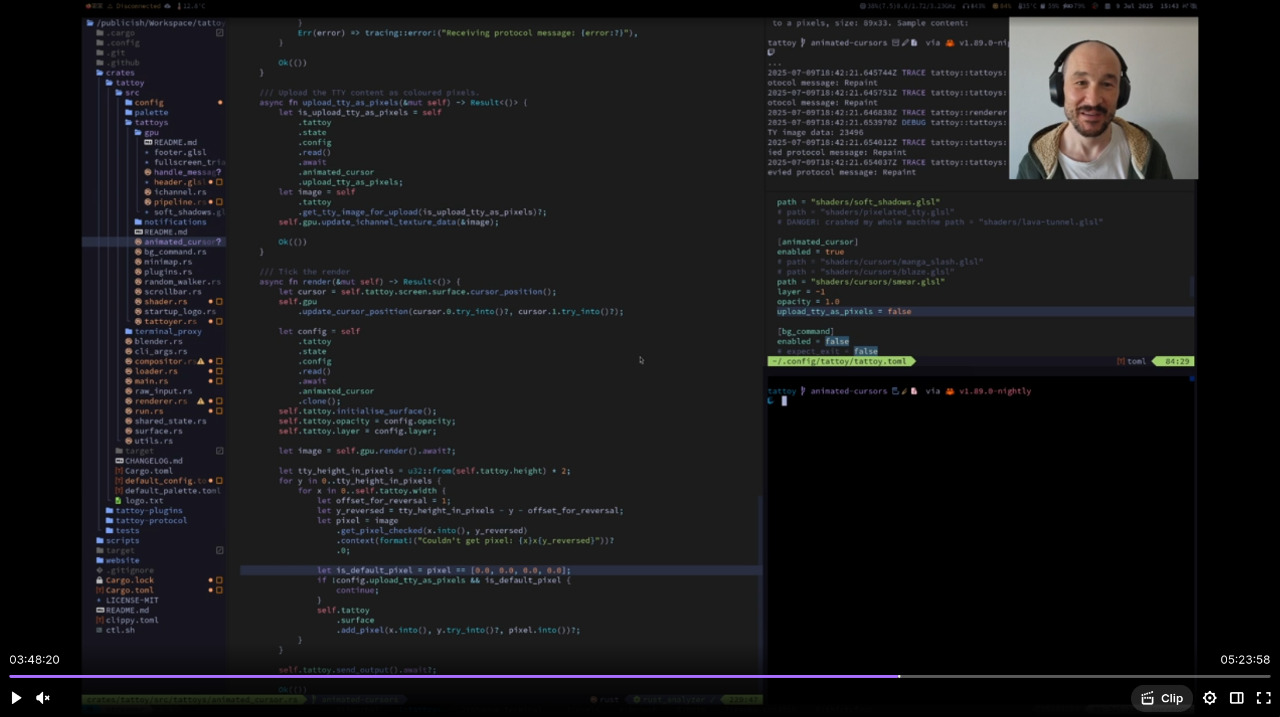
Socialising
Perhaps the biggest aspect for me, as a long-term digital nomad, is being able to easily interact with like-minded people no matter where I am in the world. I’m lucky enough to most days have between 0 and 10 viewers watching me at any given time. Some are chatty and some just lurk. Some ask me about my code and others share where they’re at with their code. People don’t normally watch me as their single focus, I’m most often on their second or third monitor as they tinker with something else. Sometimes conversations are technical and others are intense political debates. Often I’m just silent, lost in my code for hours without a single interaction.
The thing about being “in public” is that you tend more to inhabit your better self. Straighter posture, no nose-picking, no doom-scrolling, no Youtube rabbit holes … or at least not so many. But I also lean towards better coding practices, like designing before implementing or doing the boring refactor before adding the exciting feature. Although all that may partly be to do with the potential judgement of my peers, it feels more that it’s simply harder to hide from myself. I already know full well which practices make for better code, but like so many things in the privacy of our own minds and homes, our standards drop when nobody’s watching.
Some of these benefits certainly also happen in professional offices and coworking spots. But there are two big differences; firstly it’s generally frowned upon for coworkers to stare at your screen and secondly, you can’t monologue out loud.
(That thing of how it feels weird to let somebody look at your phone)
Deep At The Coalface Of Our Editors
As the scriptures state: deep and subtle are the minds of the great software engineers, one innocent question about the weather and all their mental focus and context is lost. I mock not because I’m a heathen to the faith, but because I sense that too often this is used as an excuse for disengaging with the real world with which our programs must inevitably interact.
Yes we must dig deep into the dark and lonely depths, not for diamonds, but for nutrients and stability. A finished program may feel like a precious stone, but it is in fact more like a living plant, half roots, half leaves. The programmer and the program need both the nutrition from the silent depths and the light from the chaotic heights on a daily basis.
Rubber Ducking
Of course you don’t have to monologue, plenty of software streamers stream with neither their camera nor microphone turned on. But I’ve taken to it for various connected reasons that all revolve around the well known practice of Rubber Ducking.
Namely where simply the mere act of articulating your coding problem to a real, but inanimate rubber duck sitting on your desk is enough to help you work out a solution. In some ways I think this is the preeminent reason why streaming is so beneficial to coding
Rubber Ducking and Premature Optimisation are two sides of the same coin.
Some Clips
- Here’s a clip of me when I first got automatic text contrast working for my Tattoy project.
- And here’s a clip of me suddenly falling out of view because my “seat” burst!